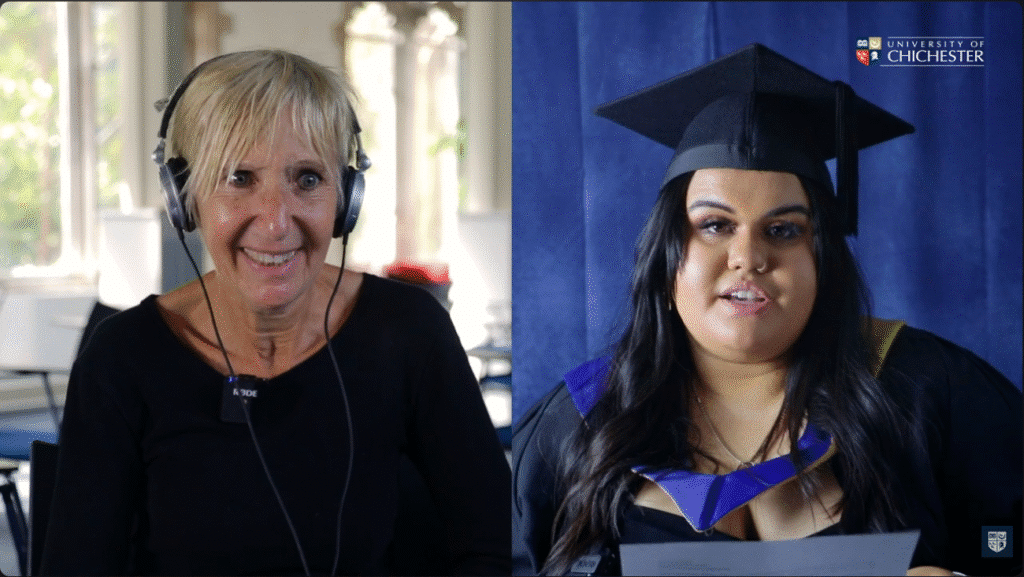
For the latest instalment of our HE Copy We Love series, we’ve picked one straight from the heart – the University of Chichester’s ‘Thank You Letters’.
If you’re an HE marketer, you already know how hard it can be to represent student voices in your comms.
It’s not about just getting one of your usual suspects to recite scripted platitudes for a TikTok reel. You’ve got to find something that galvanises the whole of your student community.
Harry and his ex-colleague Mikki from the University of Chichester found something. Their ‘Thank You Letters’ video series has been running for three years now, and students from every faculty are still lining up to get involved.
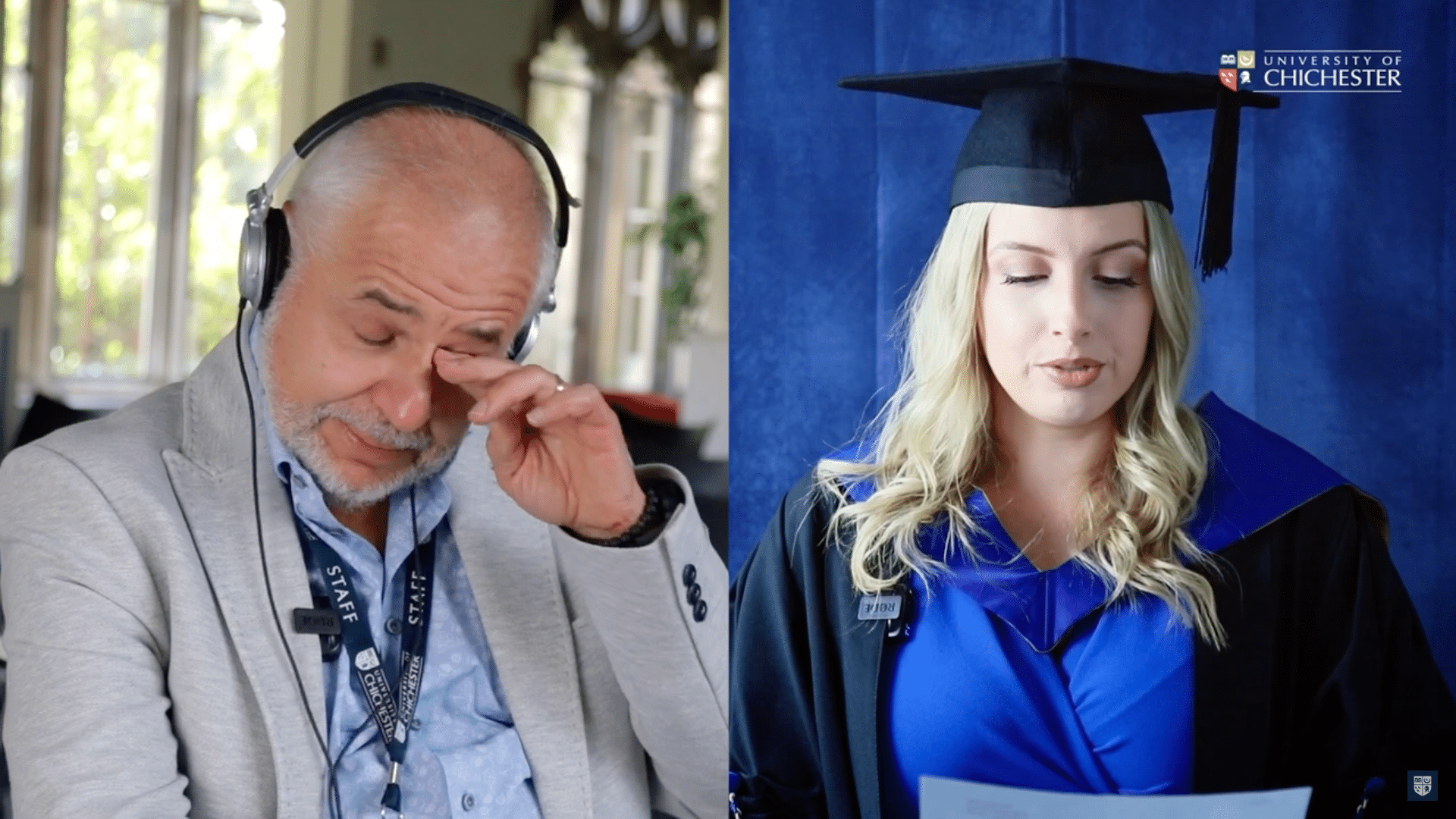
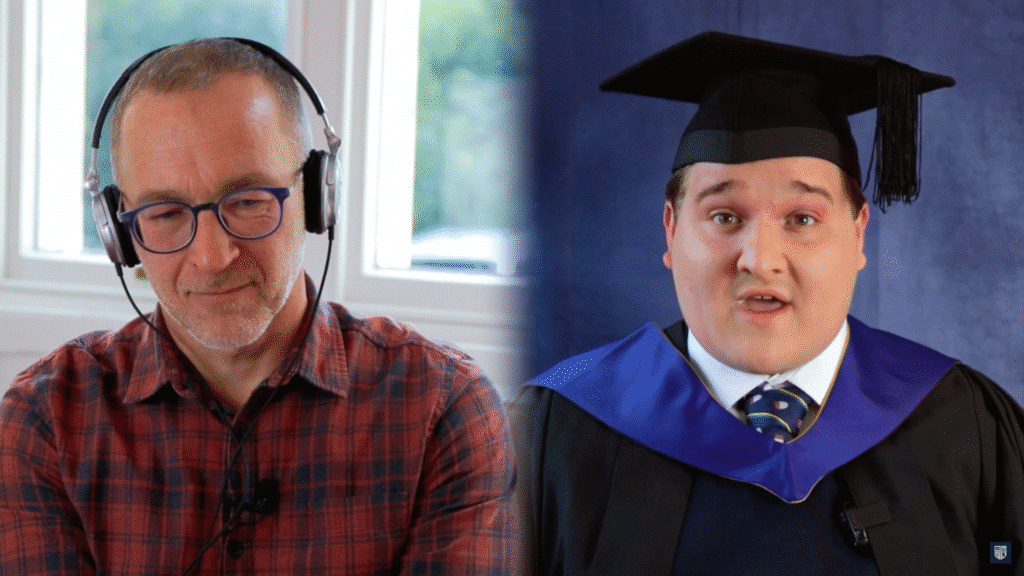
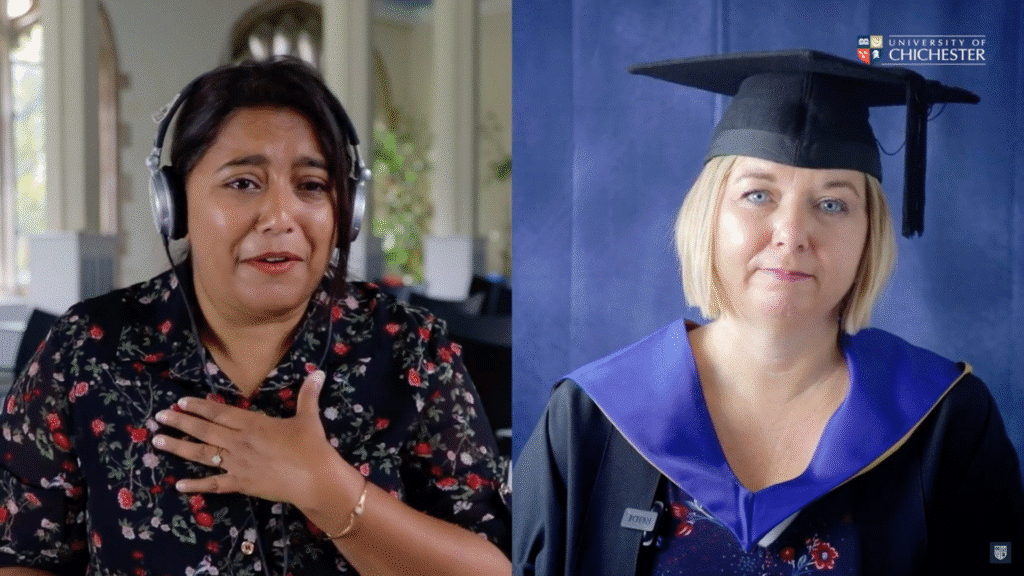
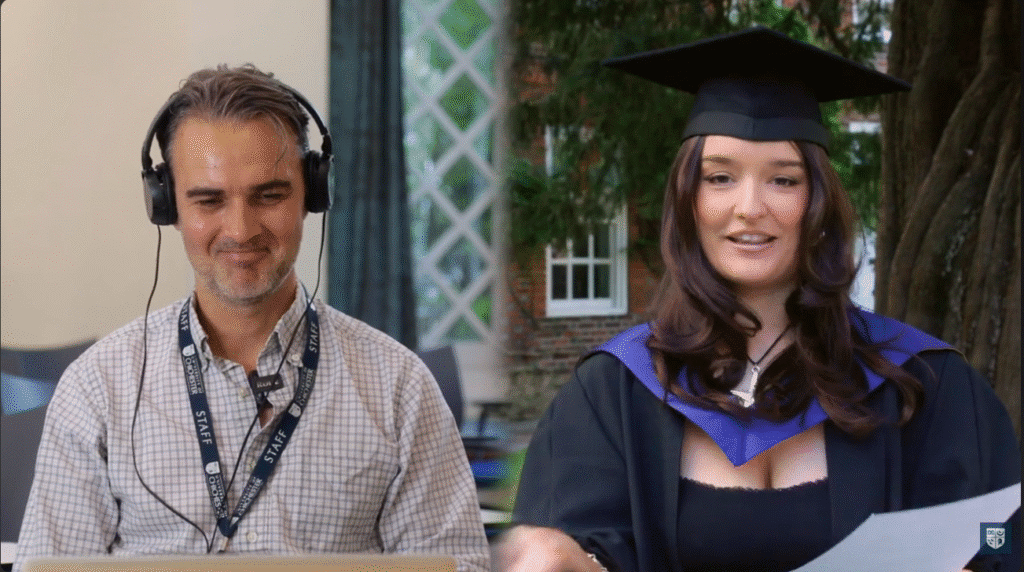
The idea sounds simple – a reaction video, where a lecturer watches one of their students reading a thank you letter after graduation.
The ‘Thank You Letters’ campaign also pulls off one of the hardest tricks in creative communication – an appeal that’s both highly specific and universally relatable. It’s specific to the individual experiences and to Chichester’s pastoral approach. And it’s universal because…well, didn’t everyone have a favourite teacher at some point? (I bet you’re thinking of them right now).
“You’ve become a valued and trusted advisor. I’ve learned so much from you…the most important lesson is that you should make things that you care about…and that if you build from your soul, then you will always make something of which you can be proud.”
Rhys, Performing Arts student, University of Chichester
We had a chat with Chichester’s senior video producer, Harry Plunkett, and digital content producer Mikki Collins (now working for non-profit org Anthony Nolan), to find out how they put it all together.
All Things Words: Great to meet you both. How does it feel to design such an evergreen piece of communication? What’s been the impact of that?
Harry: The results have been amazing. Every year, we have students asking to take part. We’re always getting approached by staff, with such gratitude for the series, too.
It’s a reminder for everyone about how wonderful the university experience can be. The raw emotion and feeling that each student puts into their letter, it’s so open and honest – it’s extremely authentic.
It creates this ripple effect of positivity, too. The lecturers involved get very emotional receiving their letters. Several of them have contacted us after filming to tell us how much they needed this boost while preparing to begin another academic year. It helps them remember why they got into education and the impact they can have.
Since the last season, in total we’ve had a reach of over 100,000 on Instagram and just under 40,000 impressions on YouTube, with well over 100 comments from students shouting out their lecturers or tagging their friends to share it.
Mikki: That’s an important point – the comments and shares provide an extra, secondary impact. It’s an opportunity for other students who weren’t involved to publicly share their appreciation for that lecturer.
“I will always remember the day I sat in your and Lucy’s office and cried for quite some time. You were so patient, sharing that you both also had these moments. That it was okay to feel this way, and that I could – and should – talk to you more because, as you said, talking helps us cope.”
Libby, counselling student
ATW: How did the idea develop? What problem were you trying to solve?
Mikki: It was about trying to differentiate the Chichester experience.
Whenever we asked students for testimonials, they were all similar – ‘you’re a name here, not a number’, or ‘the lecturers know all their students by name’.
And this is a very accurate, universal experience for most students at Chichester. We knew our students cared deeply about their lecturers, from all our interactions creating content with them. But we were always saying it – never proving it. And a lot of these sayings are things that other universities say too.
Also, we didn’t just want to show how much the students value their lecturers. We wanted to show how much the lecturers care about their students as well.
Harry: For a lot of the campaigns we’d collaborated on, we were trying to do something different, and draw on experience and ideas from outside the sector. Our view is that our content isn’t just competing with other universities – it’s competing with every single source of content that our prospective students follow or engage with.
We’d already come across an American video where adults talked about the influence of their favourite teacher, and were then filmed being surprised by that teacher decades later.
We posted an Instagram story Q&A box, asking graduating students to nominate a lecturer they were thankful for.
The number of in-depth messages we received took us by surprise, and helped solidify our decision to create something around this theme in a way that would resonate with prospective students.
“It makes me realise what an absolute honour it is to do this job. So thank you, that’s amazingly special to me. I’ll keep those words with me for a long time.”
Dr Steven Donbavand, Programme Coordinator for BA Sociology and BA Sociology with Criminology
ATW: Tell us about how you organised it. Was it a logistical challenge?
Mikki: It was relatively easy to do. We had a lot of students who were active on our social media, which is where we recruited them.
Harry: We took on a lot of the leg work to make it as easy as possible for the students. We kept the filming room set up throughout the graduation week, and we made sure all the students sent us their letters before the graduation day.
This meant that we only took 15 minutes of their time on the day – they only needed to pop in, read their letter on camera and then get back to their friends and family.
Mikki: To help them write their letters, we gave them written prompts and questions.
ATW: What prompts did you use? Can you share a few examples?
Mikki: Sure. Things like:
Can you describe your lecturer in 3 words?
Write about a specific time or moment where you felt most supported by your lecturer
What are you going to miss most about your lecturer?
What is your first moment you remember with your lecturer?
What are you most thankful for about your lecturer?
Harry: The hardest part was organising the reaction videos of the lecturers a few weeks later. Luckily, we had good relationships with most of the lecturers involved, so they were willing to go along with vague requests like, “We have a good surprise for you but we can’t tell you what it is… but we need to film you… we just need you to trust us for this one!”
“It’s not about the academic achievement – that’s great, but it’s really about that self-belief, and the greatest joy that we have as lecturers is watching our students bloom.”
Becky Edwards, Senior Lecturer in Childhood, Social Work and Social Care
ATW: What have been the biggest lessons you’ve learned from this campaign? What changes can we expect to see as the project evolves?
Mikki: One of the biggest things we learned was how creating the right content opens up the amount and type of students who want to work with you.
On our previous projects and campaigns, we’d put in a lot of work to try and diversify the students we were working with, but this campaign really managed to do that.
As for future developments, I don’t actually work at Chichester now – I was only involved in the first season, so I’ll let Harry answer that!
Harry: We’re getting ready to launch the fourth season this month. The thank you letters are such a perfect format, we don’t want to tweak too much. That being said, it’s definitely getting harder to surprise the academics, as they’ve become much more aware of it.
We’re playing with the idea of getting thank you letters written for our amazing professional services staff – people like the library team, who are the unsung heroes of any university.
We definitely still use this project as inspiration for a lot of our work. It helps us remember the impact that wholesome, story-driven content can have with our audience.
Did these stories resonate with you? Are there any other great ways to use student testimonials that you’ve come across? If so, let us know – either on LinkedIn or at jo@allthingswords.co.uk.